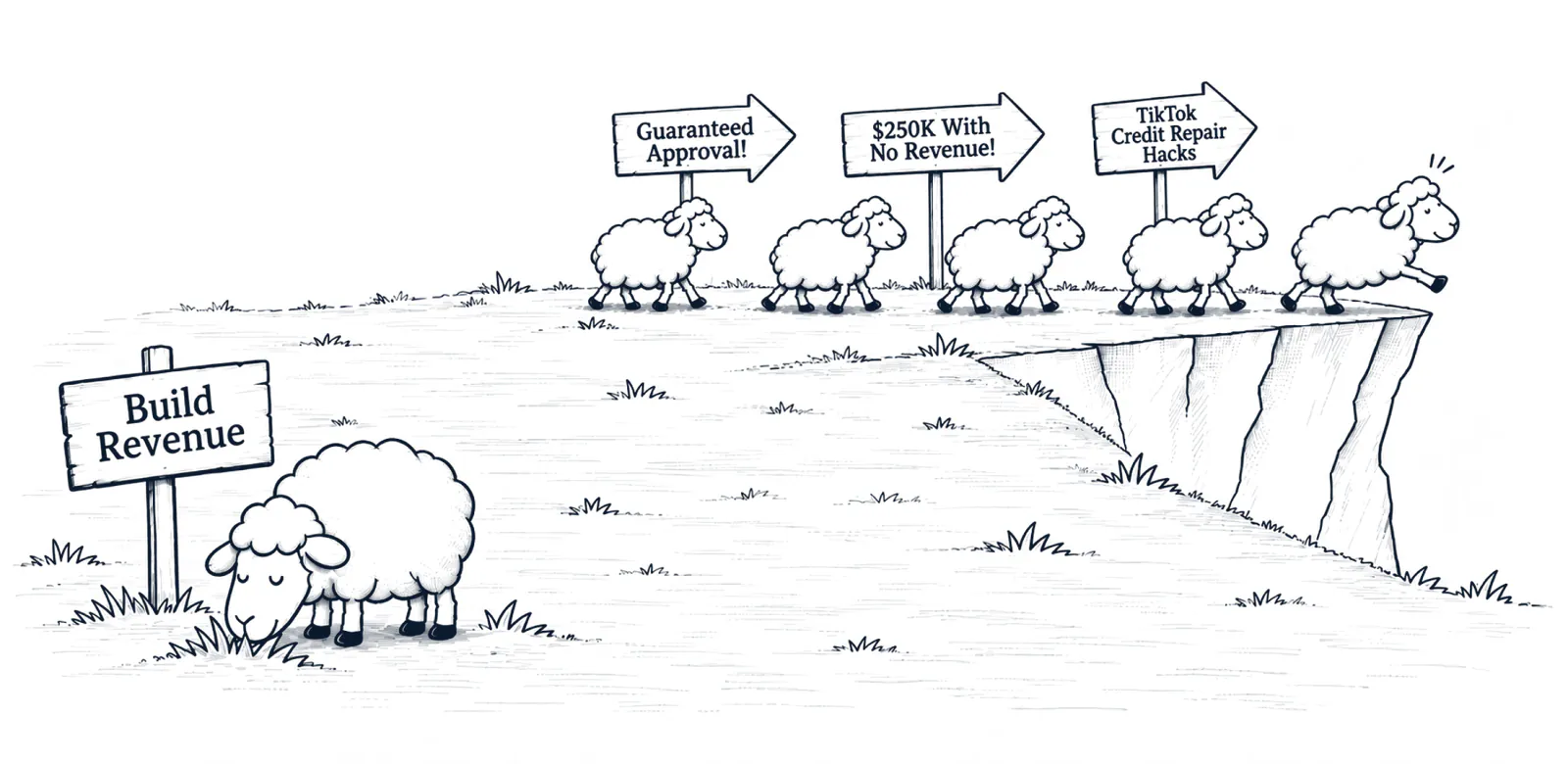
Let’s talk about one of the biggest problems I’m seeing in the business funding industry today.
There’s far too much inconsistency, not just among lenders, but in the expectations merchants have when they apply for funding. The good news is that much of this can be prevented during the intake process through honest conversations and proper education.
Business funding is a partnership. It’s a dance between the merchant and the Funding Strategist. Both sides have a responsibility to be transparent, realistic, and consistent from the very beginning.
The biggest issue I’m seeing right now?
Merchants generating $5,000 per month in revenue are applying for $50,000, $100,000, even $200,000 in funding with no realistic ability to repay those amounts.
That’s not how lending works.
The Three Pillars of Business Funding Strength
Every lender evaluates three core areas:
Personal and Business Credit
Business Revenue
Time in Business
Think of them as the three pillars holding up your funding profile.
One out of three may get you some financing.
Two out of three will usually open more doors.
Three out of three puts you in the driver’s seat with the best products, lowest rates, and strongest approval odds.
Unfortunately, the internet has convinced many business owners that none of those things matter.
Every day I hear:
“I have no revenue yet.”
“My personal and business credit isn’t great.”
“I just started the business.”
“I need $150,000 to get going.”
Let’s look at a real example.
I recently spoke with a business owner whose personal credit score was in the low 500s. He had no business revenue because he said he couldn’t start generating income until he purchased a piece of equipment costing approximately $150,000.
When lenders declined the request, his response was:
Nobody wants to give me a loan.
The reality is much simpler.
It’s not that lenders don’t want to help.
It’s that there is no evidence today that the loan can be repaid.
Lenders aren’t investing in ideas. They’re investing in the demonstrated ability to repay borrowed money.
Without revenue, without established personal and business credit, and without operating history, there simply isn’t enough information for most lenders to justify that level of risk.
Common Sense Is the Fourth Pillar
Here’s where I’m going to add something that isn’t found in any underwriting manual.
I believe there’s actually a fourth pillar of business funding:
Common Sense.
Today we’re surrounded by artificial intelligence, social media “gurus,” and advertisements claiming everyone qualifies for six-figure funding with no credit, no revenue, and no business history.
People are relying on AI to read contracts, create business plans, and tell them how funding works, but too many have stopped asking a simple question:
Does this actually make sense?
If your business deposits $5,000 per month, applying for $200,000 isn’t a funding strategy.
It’s wishful thinking.
If you have no revenue, no established personal and business credit, and no operating history, lenders aren’t rejecting your dream.
They’re evaluating risk.
That’s their job.
Become Fundable Before You Apply
Instead of applying for financing you’re unlikely to qualify for, spend your energy becoming the type of business lenders want to finance.
Improve your personal and business credit.
Build consistent revenue.
Keep accurate financial records.
Open and properly use a business bank account.
Establish time in business.
Strengthen your business credit profile.
Work with a knowledgeable Funding Strategist who understands how lenders evaluate businesses and can help position you for success.
The stronger your foundation becomes, the more financing options become available, and the better those options become.
Final Thoughts
Business funding isn’t about luck.
It isn’t about finding the one magical lender who ignores risk.
It’s about preparation.
The merchants who consistently receive the best financing aren’t necessarily the smartest or the biggest.
They’re the ones who understand what lenders are looking for and spend the time building a business that meets those expectations.
Do your research. Work with a trusted Funding Strategist. Understand how lenders think.
Become fundable before you pull the trigger.
You’ll save yourself a lot of frustration, and you’ll dramatically improve your chances of getting approved.
Mind Your Business. We’ll Help.